

It's Not Even Your Fault, Blame Urban Planning

We live in a world where it’s easy to internalize problems as personal failures: “I’m exhausted,” “I can’t sleep,” “I feel lonely,” “I’m always worried about money,” “I don’t feel safe.” But many of these experiences are, at times, less about personal shortcomings and more about the design of the cities we live in. Here’s a look at five things people often blame themselves for.
1. Burnout

Feeling constantly drained is often framed as a YOU problem: maybe YOU’RE “not managing your time well” or “YOU’RE not motivated enough.” But city design plays a huge role in what we spend time doing and how we expend our energy.
Commute stress: Lengthy commutes and unreliable public transit mean more hours sitting in traffic or waiting for the bus instead of resting or pursuing personal interests. It gets old, real fast.
Example: One summer while in grad school, I was interning with a Detroit-based organization, while living in Ann Arbor. This was pre-2020… so pre-widely accepted remote work, and I’ll just say, making that hour long commute every day, made it so hard to not only relax, but to just enjoy my free time. That summer I learned a lot about what I want (and don’t want), and since then, the longest commute I’ve had was 35 minutes by train (which to me, still, isn’t as draining as driving for 35 minutes, often in traffic).
Lack of nearby amenities: When your essentials (i.e. grocery stores, gyms, childcare) are further away from home, even the smallest task can take a lot of time.
Fragmented (physical + interpersonal) connections: If you MUST drive to go everywhere in your city, because it’s time-intensive or unsafe to choose another mode, you’re going to feel that, even if you’ve never experienced anything different. Cities that require people to drive everywhere greatly reduces opportunities for casual social interaction, which are crucial for mental health.
2. Bad Sleep
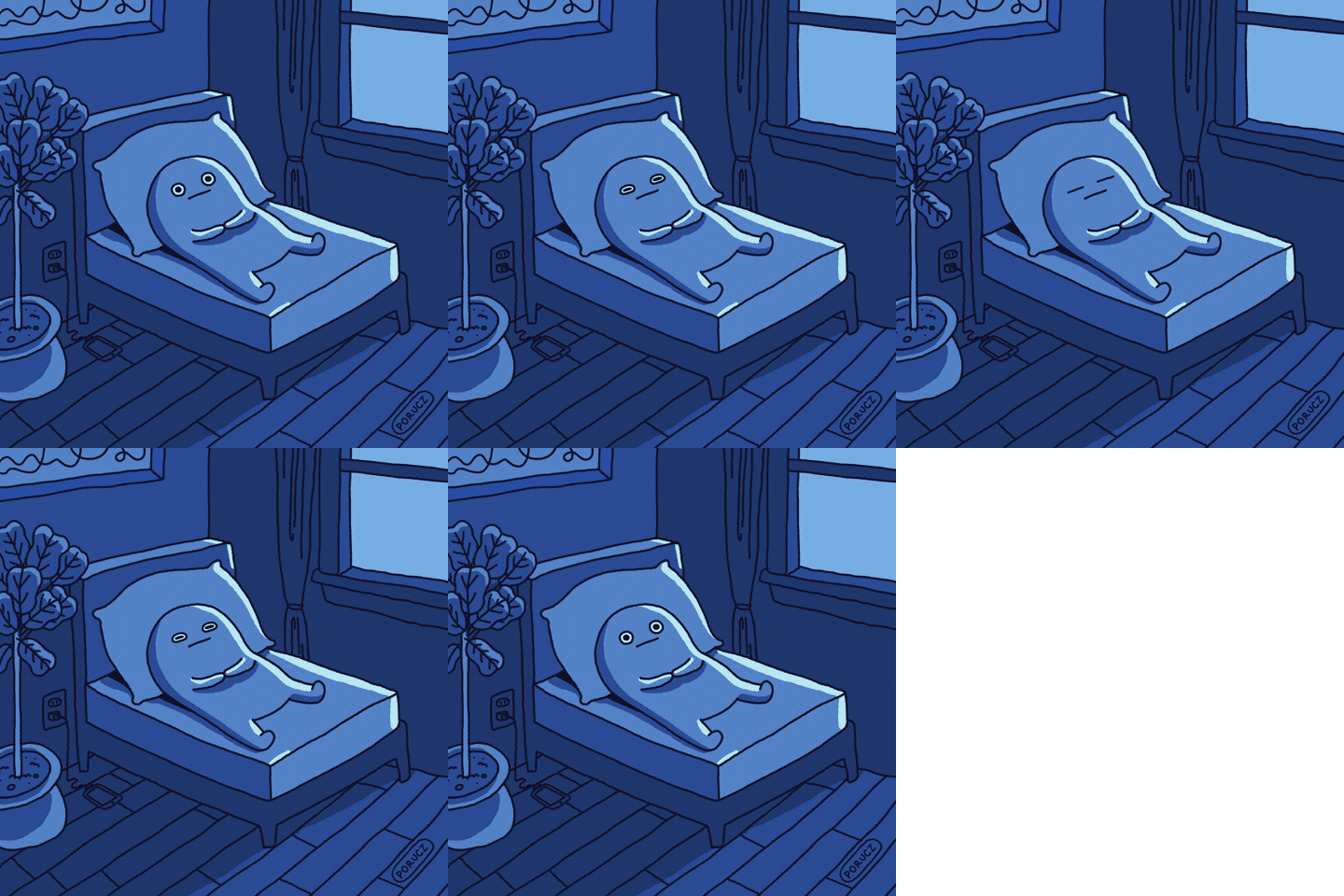
Poor sleep isn’t always a result of being overcaffeinated or lacking discipline. Your built environment plays a role.
Noise pollution: As you’d guess, constant, outside noise is disruptive to sleeping. Busy streets, whether bustling with people or late-night deliveries, poorly insulated buildings, and even peddle pubs can interrupt your sleep cycle.
Light pollution: Overly bright streetlights, digital signage, stadiums, factories, commercial properties can interfere with your sleep quality. Imagine having a bright light pointed at your window - been there, done that.
Stress from commuting: (yes, again) Long commutes really can be stressful!
3. Loneliness
Feeling isolated is often framed as a personal failing, maybe you “don’t try hard enough” to make friends, but urban design can push people apart.
Sparse public spaces: Cities without parks, plazas, or safe sidewalks reduce chances for casual connection.
Car dependency: (yes, again!!) If it’s difficult to walk or bike anywhere, not only are you just less likely to spontaneously interact with others who are out and about, you’re also less likely to randomly explore your neighborhood/city. I cannot tell you how many times I just strolled upon something new or interesting or fun in the neighborhood because I was out walking.
Dispersed communities: (yes, again!!!!) Car centricity is taking the fun out of everything. When housing and services are spread out, it’s harder to maintain friendships and support networks.
4. Debt

While individual financial habits matter, cities can make managing money more difficult than it should be.
Cost of transportation: The cost of car ownership (gas, insurance, maintenance, and parking) is often unavoidable in suburban or poorly connected areas, and for many people, it’s incredibly prohibitive. When something goes wrong with a car, the repair itself may be unaffordable, triggering a larger problem: without a reliable way to get to work, it becomes even harder to earn the money needed to fix the car in the first place.
Housing market pressures: We all know we’re deep in a housing crisis - the cost of rent is asinine, finding a starter home that’s actually priced like one seems damn near impossible. Cities with limited affordable housing stock force people into expensive rentals or long commutes (yes, it’s all interconnected!).
Limited local resources: (yes, again!!!!!) When amenities aren’t nearby, people pay more for convenience (think delivery fees, rideshare,).
5. Safety Anxiety

Feeling unsafe isn’t just a personal perception, it’s heavily influenced by the built environment.
Absence of pedestrian/bike infrastructure: Have you ever walked or biked somewhere that made you feel like you shouldn’t be there? No sidewalk, no crossings, no bike lanes, anything? Infrastructure that ignores human-scale safety makes even the shortest trips not only stressful, but dangerous.
Poor lighting and visibility: Dimly lit streets and blind corners increase anxiety about walking at night.
Example: I’m currently working on a pedestrian bridge project in Metro Detroit and we conducted a survey and focus groups to understand how people use these pieces of infrastructure. A comment that surfaced a few times was how unsafe people feel on the bridges due to lighting, the lengthy distance of the bridges, and how they can’t see who may be entering the bridge because of the placement of the ramps.
Neighborhoods without neighbors: Cities that prioritize cars over community spaces reduce opportunities for “eyes on the street”. Urbanist Jane Jacobs coined the phrase, meaning that the presence of many people (residents, business owners, passersby) using and observing public spaces inherently deters crime or poor behavior.
